Best Dunning Software Compared for 2026
Compare the best dunning software for 2026. We break down pricing, features, integrations, and recovery rates for Churn Buster, Churnkey, Stunning, Baremetrics Recover, Paddle Retain, and ChurnWard.

Failed payments account for 20 to 40% of all subscription churn, and most of it is entirely preventable. The dunning software market has matured considerably, splitting into dedicated dunning platforms, AI-powered recovery engines, hybrid retention suites, native billing tools, and even human-powered services. Choosing the right tool comes down to three things: your billing stack, whether you need voluntary churn prevention alongside payment recovery, and your budget. This comparison covers six leading tools in depth, with current pricing, features, integrations, and an honest assessment of each.
Key takeaways
- Churn Buster is the strongest choice for Shopify and Recharge eCommerce brands, with a decade of optimisation data and an average 50.3% recovery rate. Plans start at $249/month.
- Churnkey is the most feature-complete option for SaaS companies on Stripe, combining cancel flows, AI-powered retries, and a unique Failed Payment Wall. The most useful features require the $700+/month tiers.
- Stunning delivers remarkable value at roughly $120/month for Stripe-only businesses that want lifecycle email coverage without complexity.
- Baremetrics Recover makes sense primarily for teams already invested in Baremetrics analytics. Pricing starts at $69/month for up to $10K MRR.
- Paddle Retain (formerly ProfitWell Retain) offers the broadest billing platform compatibility and is included free for Paddle Billing customers. Standalone pricing starts at $500/month.
- ChurnWard is built for bootstrapped SaaS founders who want automated dunning at a flat $29/month, with no percentage-based fees or MRR-based pricing tiers.
Churn Buster: the veteran eCommerce specialist

Churn Buster has been focused exclusively on subscription churn recovery since 2013. Plans start at $249/month and scale with subscription volume. Three configurations are available: a Complete Retention Solution (dunning plus cancel flows from $249/month), Dunning Only, and Cancel Flows Only, though the latter two require a sales call for pricing. There are no contracts, and the company offers an ROI guarantee: if they do not cover their own cost, you do not pay.
Core features
The platform’s main strength is its adaptive retry logic, refined across more than 1,000 subscription businesses and millions of data points. Retries analyse decline codes, segment customer experiences, and optimise timing. Critically, retries happen before customer-facing emails are sent, letting temporary issues resolve silently. The proprietary “Churn Buster Capture” technology routes customers to update billing information without requiring a login, automatically assigning new cards to the correct subscription.
Recovery campaigns escalate across email and SMS, with support escalation for high-value customers and “last chance” discount offers as a final step. The platform reports an average recovery rate of 50.3% across all customers, with top performers reaching 94.5%.
Integrations
Integration coverage is exceptionally strong for the Shopify and subscription commerce ecosystem. Supported platforms include Stripe, Shopify, Recharge (where Churn Buster holds Premier Tech Partner status), Braintree, PayPal, Loop Subscriptions, Skio, Smartrr, Stay AI, Ordergroove, and several others. Slack, Segment, and Zapier integrations round out the stack. Notable clients include ButcherBox, Athletic Greens (AG1), MeUndies, Black Rifle Coffee, and Ghost.org.
Limitations
Churn Buster is not fully self-serve. Rollout requires interaction with their account services team, which can feel slow for teams wanting instant deployment. The cancel flows product is relatively new compared to the mature dunning engine, and the platform is optimised primarily for eCommerce and DTC brands rather than pure SaaS. English-only support is another limitation for global businesses.
Churnkey: the AI-powered retention suite for SaaS
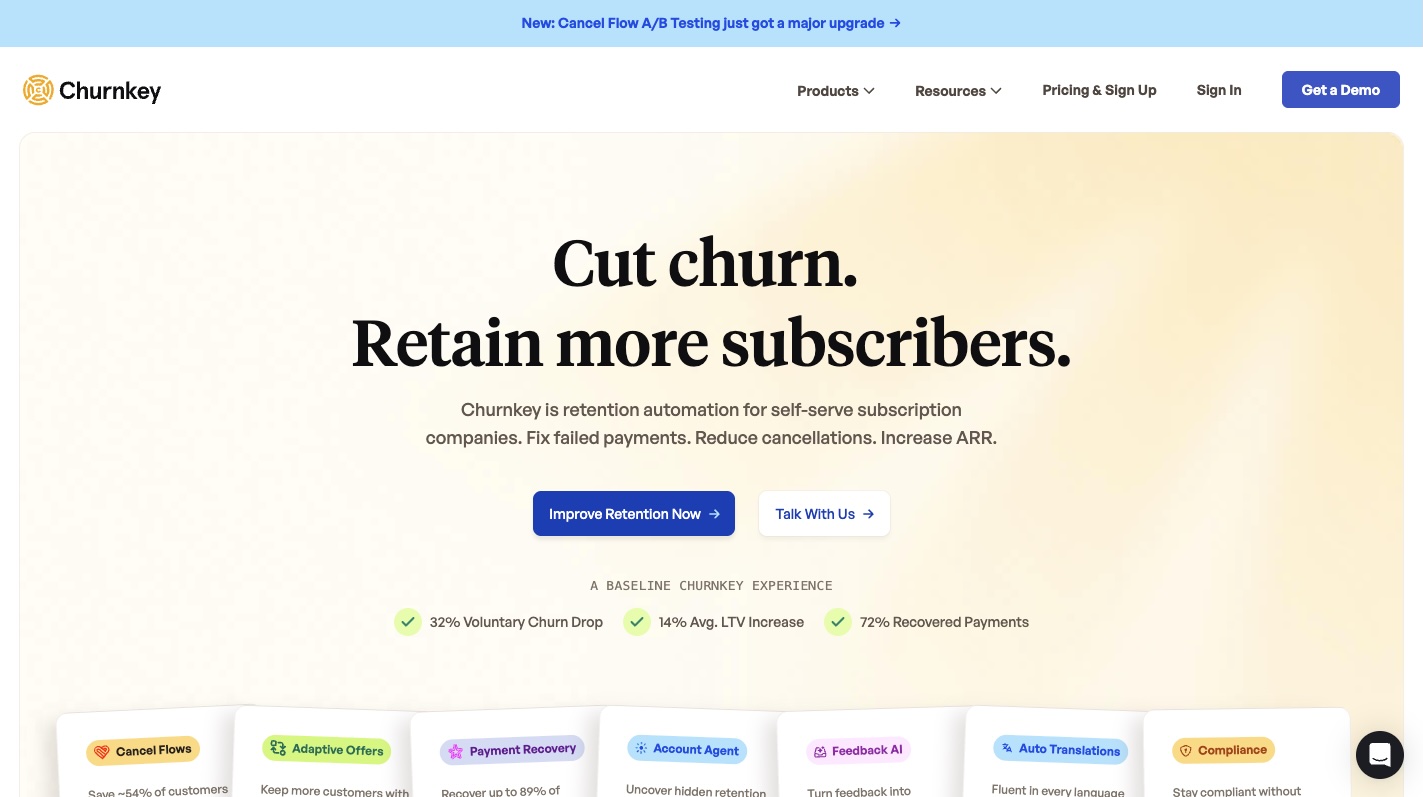
Churnkey, founded in 2020, takes a broader approach by combining cancel flow management, payment recovery, feedback analysis, and reactivation campaigns in a single platform. Pricing scales with monthly churn volume and is billed annually. At the $20K/month churn volume tier, plans break down as follows:
- Starter at $250/month covers cancel flows, payment recovery, and customer timelines.
- Core at $700/month adds A/B testing, unlimited segmentation, rules-based retry logic, and native integrations.
- Intelligence at $825/month adds Adaptive Offers, Feedback AI, AI-powered translations, self-improving Precision Retries, and compliance automation.
- Enterprise offers custom pricing with a dedicated CSM, shared Slack channel, quarterly reviews, API access, and SLA support.
A 14-day free trial is available for Starter and Core plans.
Core features
The standout feature is Churnkey’s three-layer involuntary churn approach: ML-powered Precision Retries (analysing time of day, card type, location, and decline codes), segmented dunning campaigns across email, SMS, and in-app messaging, and a unique Failed Payment Wall that dynamically blocks feature access until payment is updated. The company reports that Precision Retries account for 66% of all recoveries for some customers, and the Failed Payment Wall adds an additional 4 to 12% recovery lift.
Cancel flows are equally sophisticated, with session replay, A/B testing, and dynamic offers (pause, downgrade, discount, seat handoff). Churnkey claims these flows save roughly 54% of customers who initiate cancellation. The Intelligence plan’s Feedback AI groups freeform cancellation feedback into emergent themes, ranks their revenue impact, and supports multi-language analysis.
Integrations
Supported platforms include Stripe (deepest support, including the Failed Payment Wall), Chargebee, Braintree, Paddle, and Maxio, plus HubSpot, Intercom, Slack, and webhooks. Feature parity varies widely across billing providers, with Stripe users getting the fullest experience. Notable customers include Superhuman, VEED.io, Jasper, Copy.ai, and Gamma.
Limitations
The primary drawback is the Stripe-centric architecture. The Failed Payment Wall is Stripe-exclusive, and non-Stripe integrations lack some features. The Starter plan’s feature gating (no A/B testing, no segmentation, no Feedback AI) means the most compelling capabilities require the $700 to $825/month tiers, which is a significant investment for smaller SaaS companies. Developers have also flagged testing limitations, including no Sandbox support and non-functional payment links in test mode.
Stunning: affordable and focused on Stripe lifecycle emails
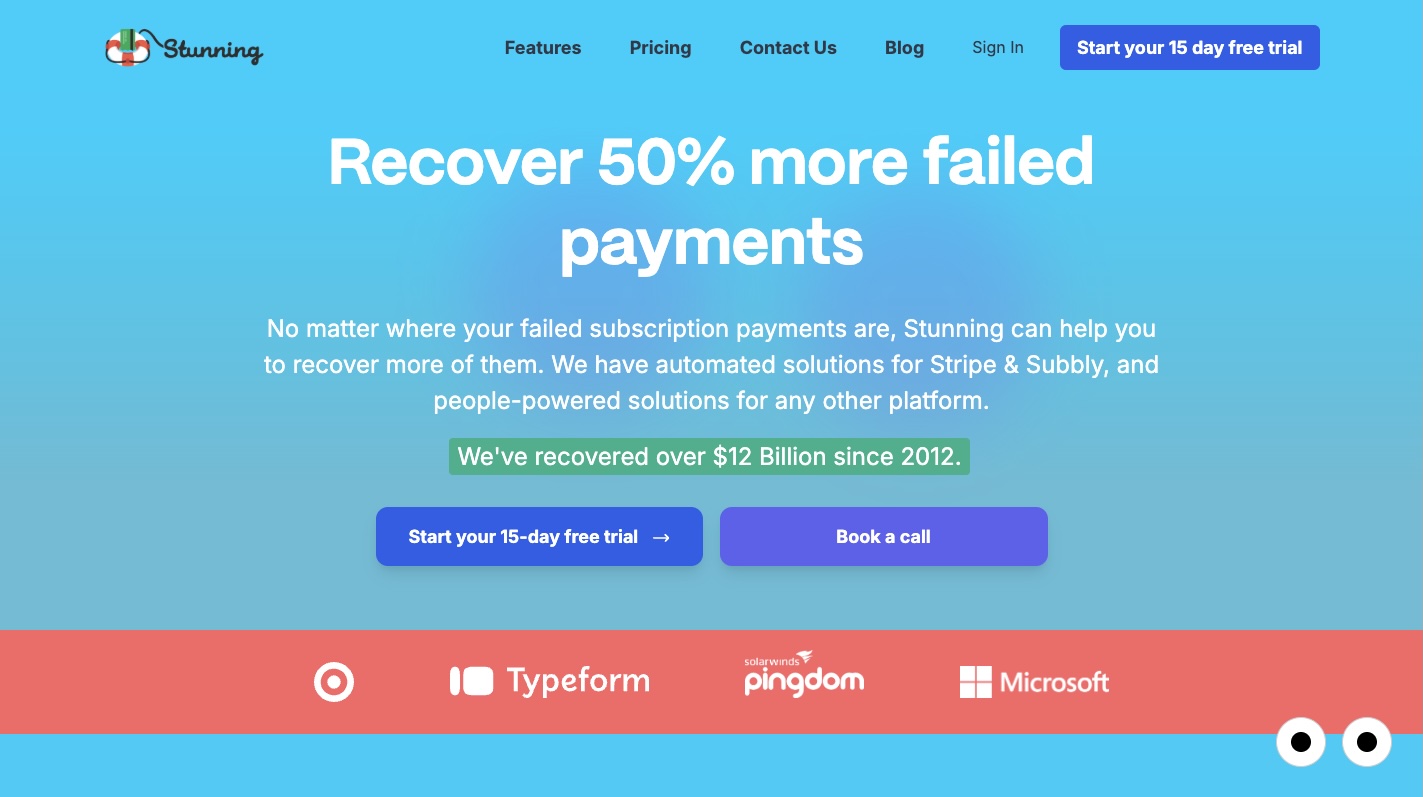
Stunning has been operating since 2012 and is the most affordable dedicated dunning tool in this comparison. Pricing is a flat monthly fee based on MRR with no percentage of recoveries taken. At $40K MRR, the cost is approximately $120/month. All features are included on every plan, with no tier-based gating. A 15-day free trial and free concierge migration are included.
Core features
The tool covers the full customer lifecycle far beyond typical dunning. Core capabilities include customisable dunning email sequences, strategic payment retries, secure payment update pages (with Apple Pay and Google Pay support), and an in-app notification bar. Stunning also handles pre-dunning (emails before cards expire, automatic card updater), lifecycle emails (welcome, trial expiration, receipts, cancellation, refund), customer self-service billing portals, and SMS dunning. The company claims to have recovered over $12 billion for customers in total.
Integrations
Stunning supports only Stripe and Subbly. If you use any other billing platform, Stunning will not work for automated recovery, though they offer a $500 one-time consultation service for businesses on other platforms.
Limitations
The critical limitation is integration scope. There is no analytics suite, no cancel flow management, and no ML-powered retry optimisation. Blog activity and social media presence appear minimal, raising questions about development velocity. That said, the product remains fully operational with active sign-up flows and is well-suited for bootstrapped SaaS companies on Stripe who want full lifecycle email management at a low cost.
Baremetrics Recover: dunning paired with subscription analytics
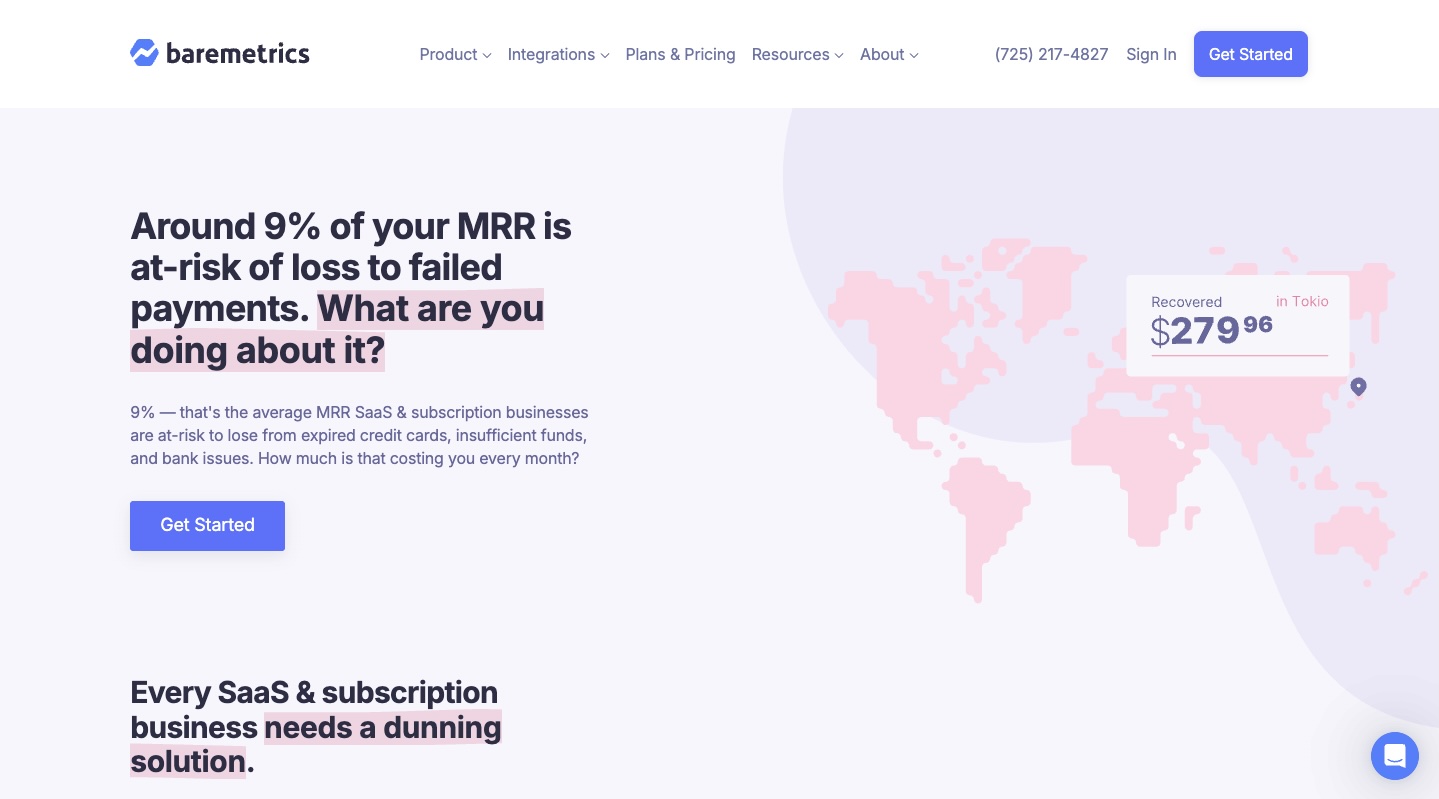
Baremetrics Recover is a dedicated dunning add-on within the broader Baremetrics subscription analytics platform. Recover is priced separately from the core Metrics product on an MRR-based scale:
| MRR tier | Monthly price |
|---|---|
| Up to $10K | $69 |
| Up to $50K | $189 |
| Up to $100K | $249 |
| Up to $500K | $749 |
| Up to $1M | $1,379 |
A 14-day free trial is available, and Baremetrics offers a guarantee: “recover more than your Baremetrics cost or your next month is free.”
Core features
Recover’s feature set includes customisable dunning email campaigns, in-app reminders, paywalls (restricting product access until payment is updated), credit card capture forms, and automatic retry logic. The real differentiator is deep integration with Baremetrics’ analytics. You can see exactly why credit cards are failing, track per-email recovery performance, and monitor recovery trends alongside MRR, churn rate, and LTV dashboards.
Integrations
The integration breadth is notable: Stripe, Braintree, Chargebee, Recurly, Shopify, Apple App Store, and Google Play Store are all supported.
Limitations
The weakness is cost accumulation. If you want both analytics and dunning, Metrics plus Recover can run $198 to $2,000+ per month depending on your MRR. Recover lacks SMS dunning, pre-dunning card expiration prevention, and lifecycle emails. It is a competent but not best-in-class dunning tool. Its value proposition rests on being bundled directly with Baremetrics analytics rather than standing alone.
Paddle Retain: the rebranded ProfitWell with broad reach
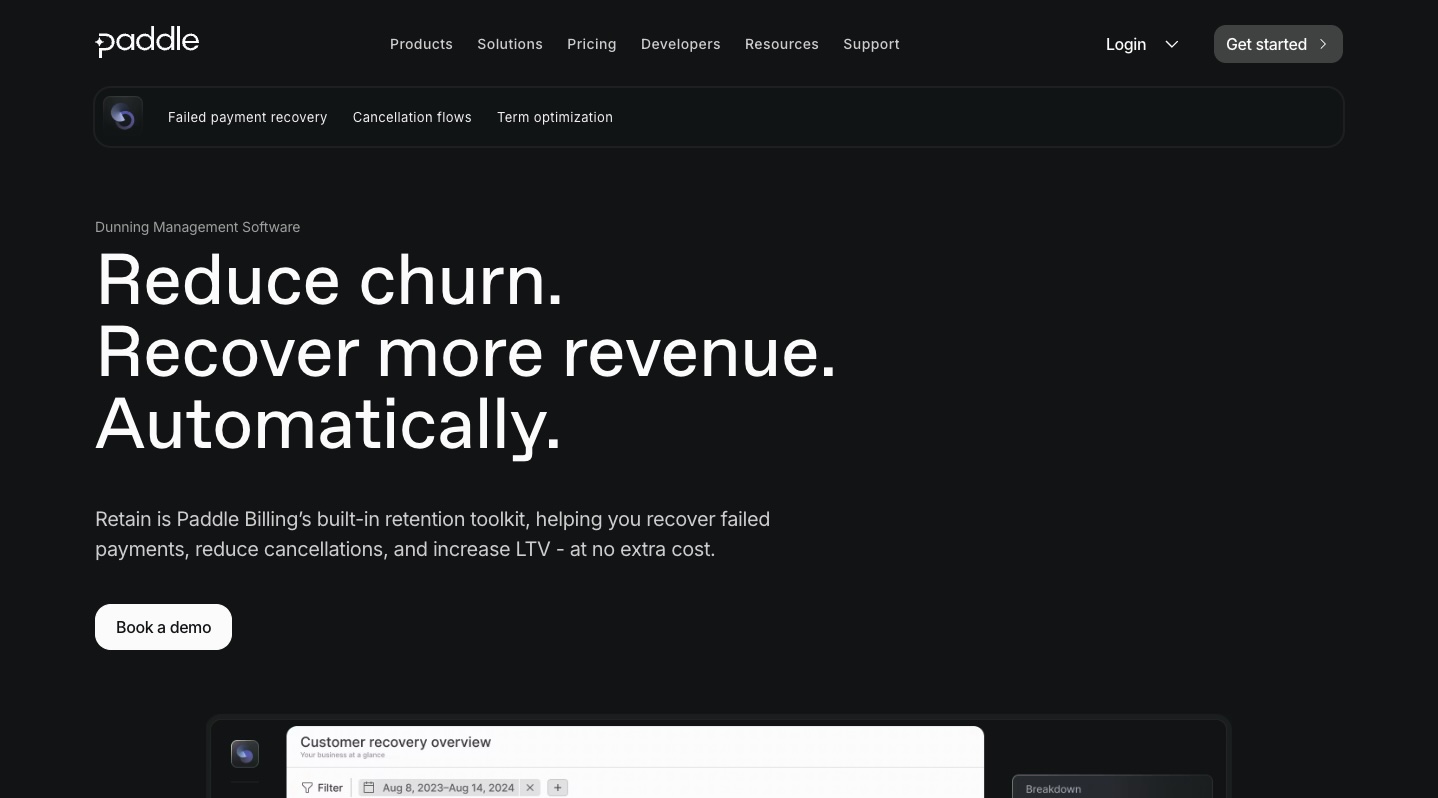
ProfitWell Retain, acquired by Paddle in May 2022 for over $200 million, is now marketed as Paddle Retain and remains actively available. New customers can still sign up. Retain operates both as a built-in feature for Paddle Billing customers (included at no extra cost within Paddle’s 5% + $0.50 per transaction fee) and as a standalone product compatible with external billing stacks.
Standalone pricing starts at $500/month flat for smaller companies, with performance-based pricing for larger accounts.
Core features
Features span both involuntary and voluntary churn: smart card retries, pre-dunning notifications, automated cancel flows with personalised retention offers (pause, downgrade, discount), term optimisation (suggesting annual plan upgrades), localisation with automatic translation, and reactivation campaigns. Paddle claims Retain delivers a 25 to 30% reduction in customer churn. In early 2026, Paddle is bringing cancellation flows directly into the Paddle Billing dashboard, signalling continued investment.
Integrations
The product supports Stripe, Braintree, Maxio, Chargebee, Recurly, Recharge, and Zuora. You do not need to use Paddle as your payment processor.
Limitations
The main concern is technology age. ProfitWell’s core retry engine dates to 2012, and at least one competitor (FlyCode) has publicly claimed it “runs on dated technology.” The $500/month minimum is also steep for early-stage companies, and the tightest integration experience is reserved for Paddle Billing customers, making the standalone version feel like a secondary priority.
ChurnWard: dunning built for bootstrapped SaaS
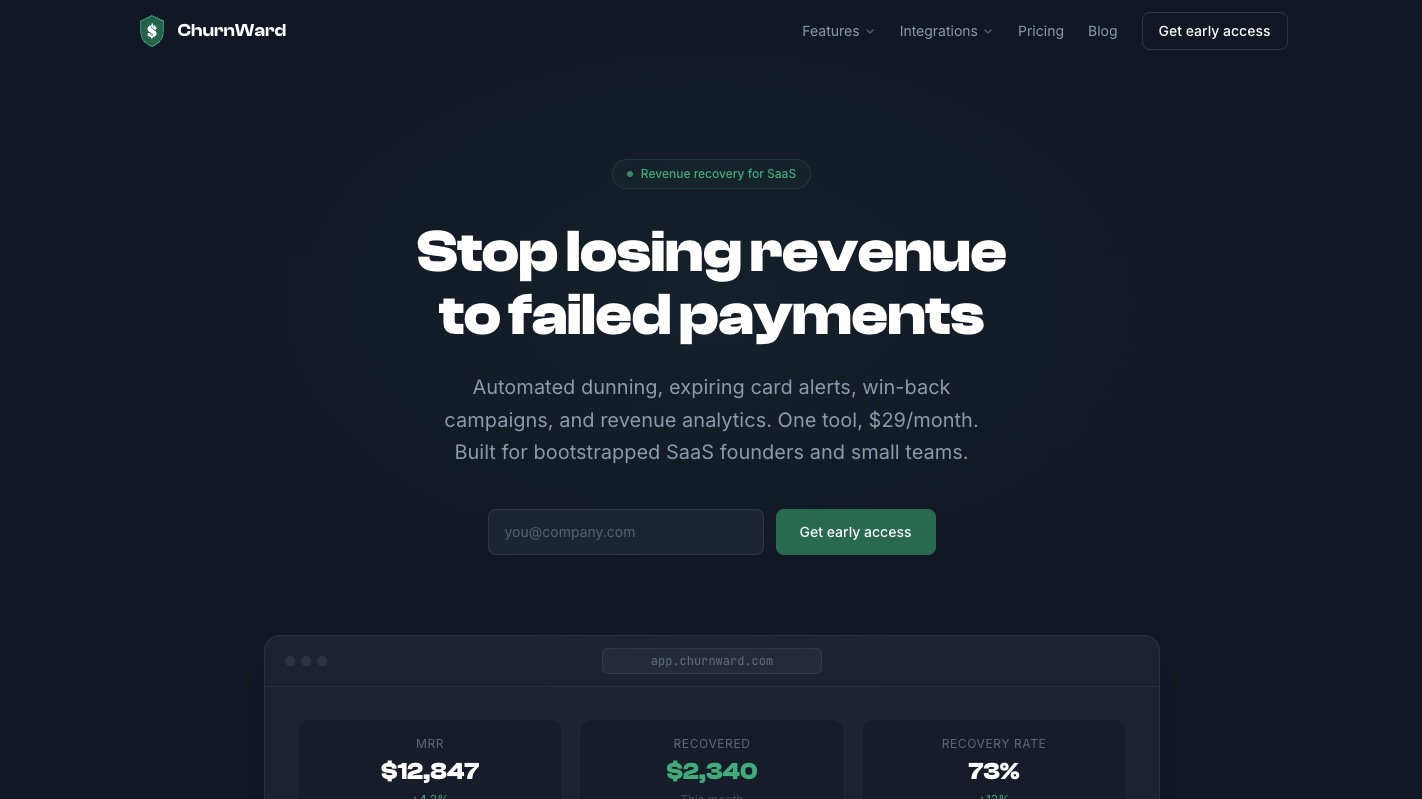
ChurnWard takes a different approach to dunning software. Rather than building an enterprise retention suite and pricing accordingly, ChurnWard is purpose-built for bootstrapped SaaS founders who need failed payment recovery without the $200 to $800/month price tag that dominates this category.
Pricing is a flat $29/month regardless of your MRR. No percentage of recovered revenue, no MRR-based tiers, no annual contracts. You can see the full breakdown on the pricing page.
Core features
ChurnWard covers the essentials that drive the majority of payment recovery: automated dunning email sequences with customisable subject lines, messages, and timing, pre-dunning card expiry alerts, payment retry logic, one-click payment update links (no login required), and a recovery dashboard showing exactly how much revenue has been saved.
The platform follows dunning best practices out of the box. Silent retries happen first, before any customer-facing communication. When emails do go out, they escalate gradually from a friendly heads-up through to a final notice, with sensible default timing that you can adjust. Win-back campaigns for lapsed subscribers are also included.
Integrations
ChurnWard supports Stripe and Dodo Payments at launch, with Paddle coming soon and additional payment processors planned. The focus is on the billing platforms that bootstrapped SaaS founders actually use, rather than enterprise systems like Zuora or Recurly.
Why it exists
Every tool in this comparison either starts at $120/month and scales with your MRR, or gates the most useful features behind $700+/month tiers. For a SaaS founder doing $5K to $30K MRR, spending $250 to $500/month on dunning software is hard to justify, even if the ROI is there on paper. ChurnWard exists to close that gap: get automated payment recovery running in minutes at a price that makes sense from day one.
The trade-off is clear. ChurnWard does not offer cancel flow management, AI-powered per-transaction ML models, or Failed Payment Walls. If you need those capabilities, Churnkey or Paddle Retain are better fits. But if you need solid, automated dunning that just works, ChurnWard gets you there for less than the cost of a single customer’s monthly subscription.
What about native billing tools?
Before investing in dedicated dunning software, it is worth understanding what your billing platform already provides.
Stripe Smart Retries
Stripe’s built-in Smart Retries are the baseline every dedicated tool must beat. They use ML trained on millions of payments to optimise retry timing across 500+ signals, and they are included at no extra cost with Stripe Billing. Combined with automatic card updater and a customer self-service portal, Stripe recovers approximately 57% of failed recurring payments natively.
The limitation is rudimentary customer communication: basic branded emails, no SMS, no in-app messaging, no campaign segmentation or A/B testing, and a maximum of three custom retries. For many bootstrapped SaaS companies, Stripe Smart Retries plus a simple email sequence is a perfectly reasonable starting point.
Recurly
Recurly’s built-in dunning is more sophisticated, offering ML-powered Intelligent Retries, Account Updater, backup payment method fallback, multiple targeted dunning campaigns (up to 50), and A/R ageing reports. The company claims involuntary churn drops from 6% to 1% on average. However, Intelligent Retries and multiple campaigns are locked behind higher-tier plans, and Recurly’s pricing is entirely custom.
Chargebee
Chargebee splits its offering into two products: built-in Smart Retry (available on the $599/month Performance plan) handles involuntary churn with up to 12 configurable retries and hard/soft decline classification, while Chargebee Retention (starting at $250/month) is a separate add-on focused exclusively on voluntary churn prevention through cancel flows with A/B testing and targeted offers.
Other tools worth watching
Butter Payments builds custom ML models per merchant, analysing 128 data points per transaction. Clients include Fabletics, Dr. Squatch, and Savage X Fenty.
FlexPay offers a dual approach with “Invisible Recovery” (silent retries) and “Engaged Recovery” (branded outreach), plus 100+ billing integrations.
Gravy takes a completely different path with human-powered recovery. A dedicated US-based team personally contacts your customers. Published testimonials cite recovery rates of 41 to 80%, but attribution is a legitimate concern, as some customers report difficulty distinguishing Gravy’s recoveries from their own existing retry systems. Pricing is a customised flat fee with no public rates available.
Slicker is a newer pay-for-success entrant emphasising multi-gateway smart routing with five-minute no-code setup.
Wrapping Up
The right dunning tool depends on your billing stack, your churn profile, and your budget. Churn Buster remains the go-to for Shopify and Recharge eCommerce brands. Churnkey is the most feature-complete option for SaaS companies on Stripe, though its best capabilities sit behind higher price tiers. Stunning offers genuine value for Stripe-only businesses wanting lifecycle email coverage at a reasonable cost. Baremetrics Recover makes sense if you are already using their analytics. Paddle Retain has the broadest billing platform compatibility and is free for Paddle Billing customers.
For bootstrapped SaaS founders who want to stop losing revenue to failed payments without committing to enterprise pricing, ChurnWard offers automated dunning at a flat $29/month. No MRR-based scaling, no percentage of recoveries, just the payment recovery fundamentals that drive the majority of results.
The most significant trend in this space is the shift toward AI-driven, per-transaction recovery optimisation. Tools like Butter Payments and FlexPay are pushing beyond rules-based retries into genuine machine learning that adapts at the individual payment level. Meanwhile, Stripe’s own Smart Retries continue improving, raising the bar that dedicated tools must clear to justify their cost. For most subscription businesses in 2026, the strategic question is no longer whether to use dunning software, but whether to invest in a dedicated platform or rely on increasingly capable native billing tools.