Customer Acquisition vs Retention: Where SaaS Should Really Focus
The 5x acquisition cost stat is unsourced, 22% of your churn is probably failed payments, and the right answer changes depending on whether you're at $1M or $50M ARR. A practical breakdown of when retention beats acquisition, when it doesn't, and the involuntary churn blind spot most founders miss.
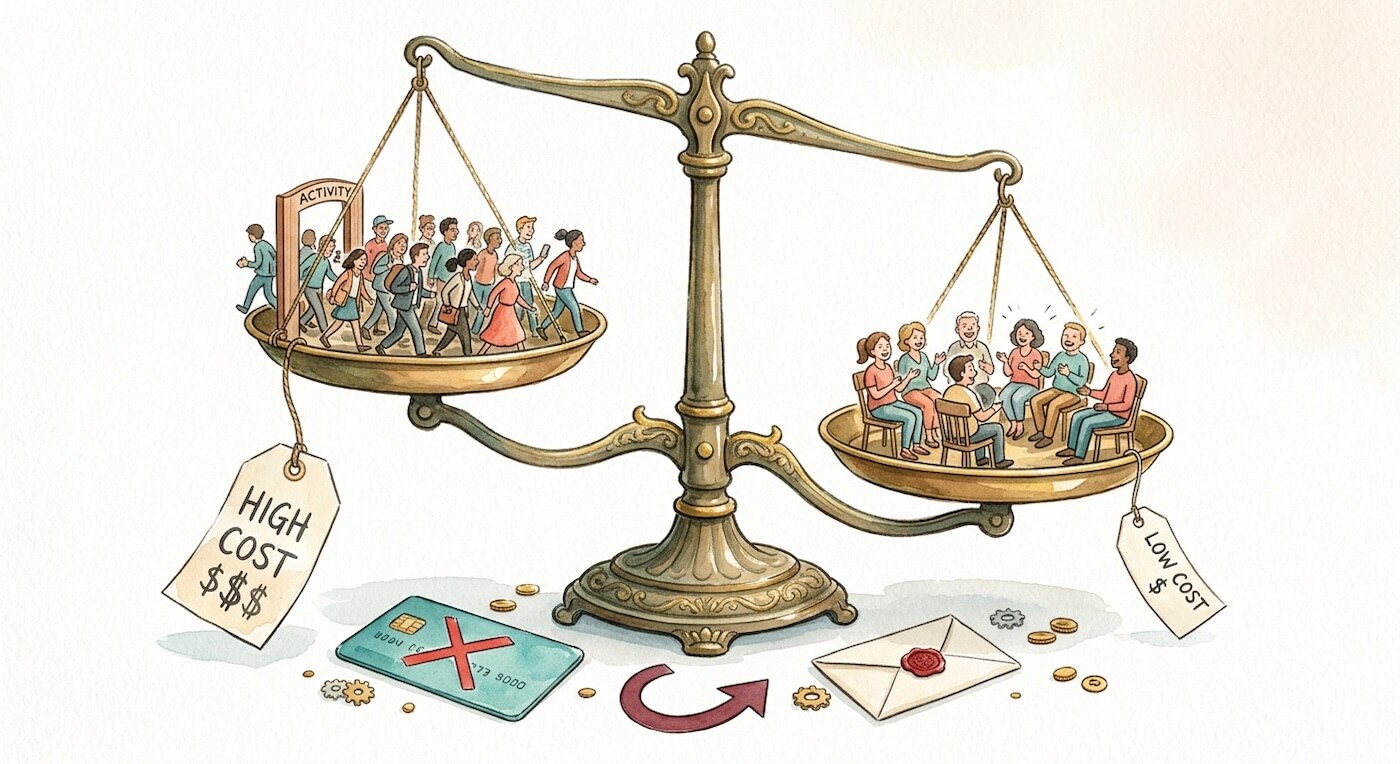
Most SaaS growth conversations treat acquisition and retention as competing priorities, when the real question is sequencing. Both matter. The answer to which deserves more focus depends on where you are, what your unit economics actually look like, and, critically, whether your churn number is telling you the whole story.
It often isn’t. A meaningful portion of SaaS churn has nothing to do with customers deciding to leave. Their payment failed. Their card expired. The bank threw a generic decline on billing day. They’re counted as churned, factored into your retention metrics, and often used to justify more acquisition spend, when the actual fix is a retry strategy and a dunning email.
Getting the acquisition-vs-retention calculus right requires understanding both the cost differential and the composition of your churn. Here’s how to think about both.
Key Takeaways
- The “5x more expensive” acquisition stat has no verifiable original study. The real range is 2x to 25x depending on industry and model. In B2B SaaS, Benchmarkit’s 2025 data shows acquisition costs exactly twice as much as expansion per dollar of ARR generated.
- A 5 percentage-point reduction in defection rate drives profit increases of 30–85% in service businesses, according to Reichheld and Sasser’s original 1990 HBR research. The “25–95%” figure quoted everywhere is a later, looser construction.
- Roughly 22% of SaaS churn is involuntary, caused by failed payments, not customer decisions. For products priced under $10/month, it’s closer to 35%.
- The stage at which retention starts to outweigh acquisition as a focus shifts around $1–3M ARR, when churn begins to compound meaningfully against a growing base.
- Companies with NRR above 120% command a 63% valuation premium over the market median. Companies below 100% NRR trade at a 46% discount.
- Involuntary churn is recoverable at 50–70% with smart retries, payment walls, and dunning sequences, at a fraction of the cost of replacing those customers through acquisition.
The cost differential is real, just not as clean as the headlines suggest
You’ve almost certainly seen the claim that acquiring a new customer costs five times more than retaining one. It’s cited in almost every article on this topic. It’s also essentially un-sourced. Multiple researchers have tried to trace it to an original study and found nothing credible. The honest formulation, from Amy Gallo’s 2014 HBR article, is that acquisition costs “anywhere from five to 25 times more” depending on the industry and study you reference. The wide range is the point.
For SaaS specifically, the clearest data comes from Benchmarkit’s 2025 SaaS Performance Metrics Report, drawn from ~1,600 private B2B SaaS companies. The median cost to generate $1 of new ARR from a net-new customer is $2.00. The same $1 of expansion ARR from an existing customer costs $1.00. Expansion is twice as efficient, dollar for dollar, and that ratio has been widening as acquisition costs climb.
CAC payback periods have stretched to a median of 18 months, up from 14 the prior year. Acquisition costs across SaaS have risen roughly 222% over eight years. Meanwhile, a customer paying £49/month with 3% monthly churn has an average lifetime of around 33 months and an LTV of roughly £1,600. Cut that churn rate to 1.5% and you’re looking at £3,200. The unit economics of your CAC change entirely depending on what happens after the sale.
Frederick Reichheld and Earl Sasser’s 1990 HBR paper found that cutting defection rates by 5 percentage points drove profit increases of 30 to 85% across different service industries: a bank’s branch system, an insurance brokerage, an auto-service chain. The “25 to 95%” version that circulates everywhere is a later construction that lost the nuance of the original. The direction is still right, though: the compounding effect of retention improvements shows up clearly in the profit line.
Why the calculus shifts as you scale
Pre-product-market fit, acquisition has to come first. You can’t optimise retention for a product whose core value proposition you haven’t confirmed yet. Early churn is signal. It tells you who the product isn’t for. Treating it as a crisis before you have a stable customer base is a distraction.
The inflection point tends to arrive somewhere between $1M and $3M ARR. Notion Capital research suggests 40% of SaaS companies never make it past $3M ARR, and preventable churn compounding against a small base is a significant part of why. At this stage, cohort retention becomes worth tracking properly. A monthly churn rate that would be manageable at $20M ARR is genuinely dangerous at $2M.
By $5M ARR, Tomasz Tunguz’s modelling shows that around 26% of revenue is already coming from renewals. By $25M, it’s 46%. Half the revenue machine is retention-driven whether you’re managing it intentionally or not. The companies that scale well treat this as an active lever, not a background variable.
The valuation data makes this concrete. Software Equity Group’s analysis of 120+ public SaaS companies found that businesses with NRR above 120% command a 63% valuation premium over the market median. Companies below 100% NRR trade at a 46% discount. Jason Lemkin’s formulation is direct: at $100M ARR with 140% NRR and a 50% growth target, 80% of that growth comes from the existing customer base. Salesforce runs 73% of new bookings from existing customers at scale. This isn’t exceptional. It’s what good retention compounding looks like over time.
The leaky bucket framing illustrates the ceiling problem clearly. A $500M ARR business with 20% annual churn loses $100M of ARR per year. The first $100M of new bookings go entirely to plugging that hole. You haven’t grown. Fixing churn at that scale has a direct, mechanical effect on growth capacity that more acquisition spend can’t replicate.
The involuntary churn blind spot
Here’s the thing most acquisition-vs-retention conversations miss: a significant portion of your churn number isn’t measuring customers who chose to leave.
Involuntary churn, meaning failed payments, expired cards, and insufficient funds at billing time, accounts for around 22% of SaaS churn according to Churnkey’s 2025 analysis of 5.4 million failed payments across Stripe. For products priced under $10/month, that figure climbs to 35%. For higher-priced products ($100–$10,000/month), it drops to 15–19%. The Zuora/GoCardless joint study puts the broader subscription range at 20–40%; Stripe states that nearly a quarter of churn is involuntary across their billing customer base.
Every major processor tells the same story. Recurly, processing data from 2,200+ subscription brands and 58M+ subscribers, reports that 53% of total churn across their platform is involuntary, though their customer mix skews toward consumer and media subscriptions rather than pure SaaS.
The practical consequence: if your monthly churn is 5% and involuntary churn accounts for 22% of it, roughly 1.1% of your customers each month are leaving because of a payment problem, not a product problem. That’s not a retention issue in the usual sense. It’s a billing infrastructure issue, and it has a very different fix.
The root causes, from Churnkey’s analysis: insufficient funds (40.6% of failures), transaction not allowed (8.8%), fraud risk flagging (8.0%), generic “Do Not Honor” decline codes (7.6%), and expired cards (1.1%). Around 30% of credit cards are reissued annually, which creates a constant pipeline of outdated payment details regardless of how satisfied those customers are.
Recovery rates on involuntary churners are high. Combining smart retries, payment walls, and dunning email sequences recovers around 70% of involuntary churn, according to Churnkey. Stripe Smart Retries alone recover 51% of failed payments, with recovered subscribers continuing for an average of 7 more months. Recurly reports a 53.5% past-due recovery rate, and found that 38% of a subscriber’s total lifetime happens after a recovery event. Recovered customers aren’t just worth recapturing once, they often become some of the most durable accounts on the books.
If you’re benchmarking retention performance without separating voluntary from involuntary churn, you’re solving a harder problem than you need to. The voluntary churn problem requires understanding why customers aren’t getting value. The involuntary churn problem requires a retry strategy and a dunning sequence. These are different interventions with different costs, and conflating them leads to misallocated spend.
ChurnWard’s dunning and failed payment recovery handles the involuntary side automatically: retries, payment update emails, and smart sequencing based on decline code. That frees you to focus retention effort on the customers who actually decided to leave.
When acquisition is genuinely the right focus
None of this is an argument against acquisition. Most SaaS businesses need both running in parallel at most stages. The question is weighting.
There are situations where acquisition deserves the heavier investment. Pre-PMF, or while still iterating on the core use case, meaningful resource toward retention optimisation is premature. If your CAC payback is under 12 months and the market is genuinely time-sensitive, the opportunity cost of slowing acquisition may outweigh the retention gains on offer. In a land-grab phase where market share now creates defensible network effects later, acquisition has a strategic urgency that unit economics alone don’t capture.
The businesses that get into trouble are the ones that stay in acquisition-dominant mode past the point where the maths supports it. If you’re past $3M ARR, running meaningful churn, and treating retention as a second-order concern, the leaky bucket is already working against you. More acquisition spend fills the bucket faster. It doesn’t stop the leak.
The practical question
If your NRR is below 85%, fixing churn almost certainly has a better ROI than increasing acquisition spend. Between 85% and 100%, both levers deserve serious investment. Above 100%, the existing customer base is compounding in your favour and acquisition becomes the primary growth constraint.
Before putting more budget into acquisition, separate your involuntary churn from your voluntary churn. On Stripe, this means looking at which churned customers cancelled their subscription versus which ones lapsed because of payment failures: the invoice.payment_failed webhook events piling up against accounts that never actively cancelled. In our experience across ChurnWard customers, the involuntary number is consistently higher than founders expect.
Those customers aren’t gone. They wanted to keep paying. The right move is to ask them back, and it costs a fraction of what it takes to replace them.
Sources
Cost Differential and CAC Data
- HBR: The Value of Keeping the Right Customers (Amy Gallo, 2014): Acquisition costs 5–25x more than retention depending on industry; widely cited but no single underlying study.
- Benchmarkit: 2025 SaaS Performance Metrics Report: Median new customer CAC ratio $2.00 per $1 ARR; median expansion CAC ratio $1.00 per $1 ARR; expansion ARR now 40% of total new ARR at median across ~1,600 private B2B SaaS companies.
- HBR: Zero Defections: Quality Comes to Services (Reichheld & Sasser, 1990): 5 percentage-point reduction in defection rate drives 30–85% profit increase depending on service industry.
Retention, NRR, and Valuation
- Software Equity Group: How Net Revenue Retention Impacts SaaS Valuation: NRR above 120% commands 63% valuation premium; below 100% NRR trades at 46% discount; based on 120+ public SaaS companies, Q2 2024.
- ChartMogul: The SaaS Retention Report, The New Normal: 2,500+ SaaS businesses; top-quartile companies at $15–30M ARR not consistently reaching 100% NRR in 2024; expansion now 40% of growth above $15M ARR.
- Tomasz Tunguz: The Strategic Shift in Revenue for SaaS Startups as They Scale: ~26% of revenue from renewals at $5M ARR; ~46% at $25M ARR.
- UserMotion: SaaS Churn Rate Benchmarks 2024: Average monthly churn 4.2% across ~1,000 B2B SaaS companies; enterprise 1–2%, mid-market 1.5–3%, SMB 3–5%.
Involuntary Churn and Payment Failure Recovery
- Churnkey: Involuntary Churn Benchmarks and Tactical Advice (2025): 22% of SaaS churn involuntary; 35% for products under $10/month; 15–19% for $100–$10,000/month; insufficient funds 40.6% of failures; 70% recovery rate with full dunning stack; analysis of 5.4M failed payments and 25M subscriptions across Stripe.
- Stripe Billing: Nearly a quarter of churn is involuntary; Smart Retries recover 51% of failed payments; $6.5B recovered for customers in 2024.
- Zuora/GoCardless: Businesses Lose Up to Four in Ten Customers Due to Payment Failure (2022): 20–40% of subscriber churn from payment failure; credit card subscriptions churn at 14% annually versus 4% for bank debit.
- Recurly: Subscriber Retention Benchmarks: 53% of total platform churn involuntary; 53.5% past-due recovery rate; 38% of subscriber lifetime occurs after a recovery event; 75% decline management efficiency rate.