What Is a Good NPS Score? SaaS Benchmarks & Context That Actually Help
The SaaS industry average NPS sits between 31 and 41, but that number shifts sharply based on company size, pricing model, and vertical. SaaS-specific benchmarks from Retently, Userpilot, CustomerGauge, and Survicate, with context on what actually drives scores up or down.
Most SaaS founders encounter the same frustrating experience with NPS: they run the survey, get a number back, and have no idea whether it’s good, bad, or meaningless. A score of 35 sounds positive until someone mentions Canva scores +77. Then it sounds terrible until you learn the average B2B SaaS company sits at roughly 36. Context changes everything.
The SaaS industry average NPS falls between 31 and 41 depending on who you ask and how they define “SaaS.” But that single number hides enormous variation by company size, pricing model, vertical, and business stage. A bootstrapped B2B tool with 200 customers operates in a completely different universe from an enterprise platform with 10,000 seats. Comparing their NPS scores without context is worse than useless.
This post provides that context. We’ve pulled benchmark data from Retently, Userpilot, CustomerGauge, Survicate, NPSpack, and SurveySparrow across their 2024-2026 reports. We’ll cover what the NPS scale means in practice, where SaaS companies actually land, what drives scores up or down, and why NPS alone won’t tell you everything you need to know about retention.
Key Takeaways
-
The SaaS industry average NPS is approximately 31-41, with B2B SaaS specifically clustering around 36. B2C SaaS scores materially higher at 47-54, a persistent gap driven by product complexity and multi-stakeholder buying.
-
Company stage matters. Startups average +28, growth-stage companies hit +33, and enterprise companies reach +35 according to NPSpack’s 2025 data across 500+ SaaS companies. A temporary NPS dip during rapid scaling is normal and well-documented.
-
Only 3% of SaaS companies achieve NPS above 70. The top scorers include GitHub (+73), Notion (+71), Stripe (+67), and Slack (+58). If you’re above 50, you’re in the top 15%.
-
Closing the feedback loop is the single highest-ROI NPS action. Companies that respond to detractors within 48 hours see a 6-point NPS lift. Those that systematically close the loop have 3x more promoters at their next survey.
-
NPS misses 20-40% of all subscription churn entirely. Involuntary churn from failed payments creates detractors out of previously satisfied customers, and no NPS survey captures it in time. Smart dunning management addresses the gap.
-
Customer effort predicts loyalty 40% more accurately than satisfaction scores alone, according to Gartner. Pair NPS with CES, usage analytics, and payment health metrics for a complete retention picture.
What the NPS Scale Actually Means
Fred Reichheld introduced Net Promoter Score in his December 2003 Harvard Business Review article, based on two years of research at Bain & Company linking survey responses to actual customer behaviour across 14 case studies spanning seven industries. The core finding: willingness to recommend was the best or second-best predictor of top-line growth in 11 of those 14 cases.
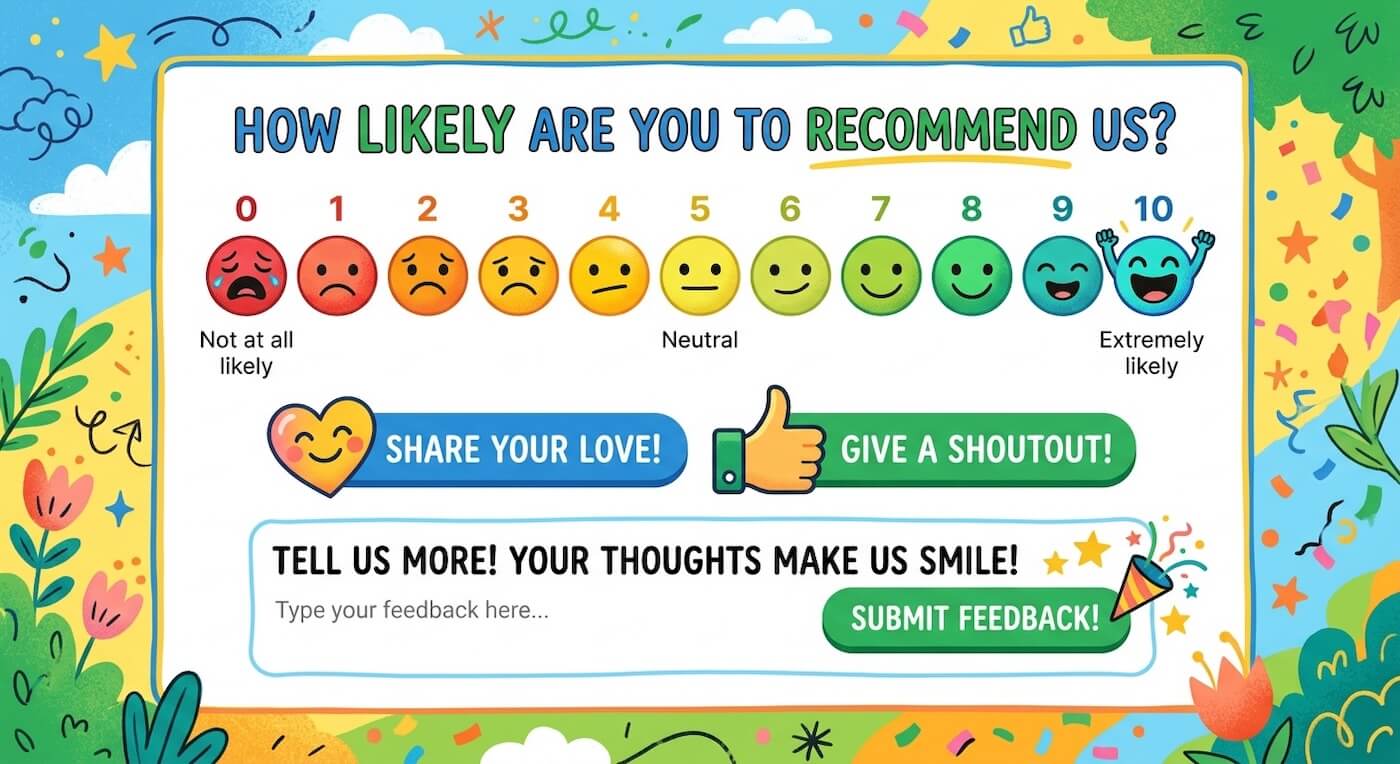
One question. That’s it: “On a scale of 0 to 10, how likely are you to recommend [product] to a friend or colleague?”
Respondents split into three groups. Promoters (9-10) are loyal enthusiasts who refer others and drive organic growth. Passives (7-8) are satisfied but unenthusiastic, vulnerable to competitor offers, and excluded from the calculation entirely. Detractors (0-6) are unhappy customers who risk damaging your reputation through negative word-of-mouth. Worth noting: 7 of the 11 scale points classify someone as a detractor. The categorisation is deliberately asymmetric.
The formula is simply % Promoters minus % Detractors, producing a score from -100 to +100. For the full step-by-step, see our guide on how to calculate NPS.
Most sources converge on these classification tiers: below 0 needs serious work, 0-30 is good, 30-50 is great, 50-70 is excellent, and 70+ is world-class. Bain’s own thresholds run slightly more generous: above 0 is good, above 20 is great, above 50 is amazing.
Here’s the thing: a MeasuringU replication study found NPS explains about 38% of variability in future company growth. That’s substantial but meaningfully lower than Reichheld’s original claim of 76%, which used historical rather than future growth data. NPS is a useful signal. It’s not a crystal ball.
SaaS NPS Benchmarks by Company Size
There is no single “correct” SaaS benchmark. The number shifts depending on who’s measuring, what they include, and how they sample. We’ve pulled the most cited 2024-2026 sources and present them side by side so you can triangulate.
The overall SaaS average
Retently’s 2025 benchmarks place B2B Software & SaaS at 41. Userpilot’s 2024 study of 229 B2B SaaS companies found an average of 35.7 with a median of 39. CustomerGauge reports +36. Survicate, working from 5.4 million responses across 599 companies, landed at a median of 38 for B2B. NPSpack’s 2025 analysis of 500+ SaaS companies shows +31. SurveySparrow’s 2026 benchmarks report a median of 30.
The variation isn’t contradictory. It reflects different methodologies and sample compositions. The working consensus: the SaaS industry average is approximately 31-41, with B2B SaaS specifically clustering around 36.
By company stage and ARR
NPSpack’s 2025 data breaks this down cleanly. Startups with fewer than 50 employees average +28. Growth-stage companies (50-500 employees) hit +33. Enterprise companies above 500 employees reach +35. The top 5% in each category score 60+, 65+, and 70+ respectively.
SurveySparrow’s 2026 data tells a similar story through the ARR lens: companies under $1M ARR average 25, those between $1M-$10M reach 32, and $10M+ companies score 35.
Userpilot found something counterintuitive in their 2024 data. Companies under $5M in revenue scored higher on average than mid-range companies ($5-10M), likely because smaller teams deliver more personalised service. The “scale-up dip” is a well-documented pattern: NPS often drops during rapid growth (typically the 50-200 employee phase) as processes strain, support quality dilutes, and feature bloat creeps in. Companies that survive this phase and reinvest in customer experience tend to emerge with stronger scores than they started with.
How SaaS compares across industries
SaaS sits mid-pack relative to other industries. Retently’s 2025 data puts Technology & Services at 66, Healthcare at 80, and Ecommerce at 59, all well above B2B Software & SaaS at 41. Internet Software & Services brings up the rear at just 16. The B2B nature of most SaaS products, with multiple stakeholders, complex integrations, and longer sales cycles, structurally suppresses NPS compared to B2C categories with simpler purchase decisions.
How NPS Varies by Segment
The SaaS average is a starting point. But comparing your NPS to the overall average without accounting for your specific segment is like comparing your 5K time to the average without checking whether you’re racing against sprinters or marathoners.
B2B vs. B2C: a persistent 13-18 point gap
Every source confirms B2C SaaS scores materially higher. Survicate’s 2025 data shows B2B at 29 versus B2C at 47. SurveySparrow’s 2026 benchmarks show a similar gap: roughly 41 for B2B versus 54 for B2C.
The reasons are structural. B2B products must integrate with existing tech stacks, serve multiple user roles, and satisfy both buyers and end users. Gainsight’s Customer Success Index found executive buyers score a median NPS of 46 versus end users at 36. That 10-point gap means who you survey completely changes what you measure.
By vertical
Userpilot’s 2024 analysis of 229 B2B SaaS companies found meaningful vertical variation. EdTech led at 47.5, followed by MarTech at 41 and FinTech at 40. HealthTech scored lower, likely due to regulatory complexity, and AI/ML products underperformed, possibly because customer expectations around AI capabilities outpace current delivery.
Vertical SaaS consistently outperforms horizontal SaaS. NPSpack reports vertical SaaS companies averaging +52 versus productivity and collaboration tools at +41 and marketing and sales tools at +31. Deeply specialised products deliver more obvious, measurable value within their niche.
By business and pricing model
NPSpack’s 2025 data reveals a model-based hierarchy. Freemium products average +42 because users self-select, and only those finding value stick around. Usage-based models hit +38. Seat-based subscription models, the most common SaaS pricing structure, score lowest at +29 because they include locked-in customers who may not be getting proportional value.
Pricing tier creates a U-shaped curve. Low-touch products ($1-50/month) average +35, mid-touch ($50-500/month) dip to +32, and high-touch ($500+/month) climb back to +41. The mid-market gets squeezed: too expensive for casual tolerance, not expensive enough to justify dedicated CSM support. If you’re a bootstrapped SaaS selling at $29/month, the low-touch benchmark of +35 is your most relevant comparison.
One more: enterprise-focused products with annual contracts score 5-10 points above SMB-focused products with monthly billing (SurveySparrow 2026). Annual contracts signal deeper commitment and typically come with more dedicated support.
What Drives a High NPS in SaaS
Onboarding speed and time-to-value
This is the single most impactful NPS driver. Totango’s data indicates 63% of SaaS churn occurs in the first 90 days after purchase. Most of those customers never reached a steady state. Gainsight’s research found customers who complete structured onboarding are 2.5x more likely to renew versus those left to self-serve.
The implication is direct: if you can compress the time from sign-up to first meaningful value, NPS improves. Self-service SaaS should target first value within 7-14 days. Enterprise implementations should aim for 30-90 days. Anything beyond that window and you’re haemorrhaging potential promoters before they’ve had a chance to experience what your product actually does.
Feature adoption depth
Pendo’s research on SaaS NPS reveals that many detractors haven’t discovered the features that would make the product sticky. They log in regularly but miss the functionality that separates a “nice tool” from an “essential tool.” Promoters tend to use more features and use them more deeply.
The practical action: identify the feature-usage patterns of your promoters, then build in-app guidance, tooltips, and proactive education to replicate those patterns for passives and detractors. This isn’t about building new features. It’s about surfacing the ones you already have.
Support responsiveness
Companies that respond to NPS feedback within 48 hours see a 6-point NPS lift according to CustomerGauge. Temkin Group’s research quantifies the behaviour gap: promoters are 5x more likely to repurchase and nearly 6x more likely to forgive mistakes compared to detractors. Every detractor left unaddressed compounds the loss.
Closing the feedback loop
This deserves its own emphasis. CustomerGauge’s data shows companies that close the NPS loop reduce churn by a minimum of 2.3% per year, while those that don’t see churn increase by 2.1% annually. Businesses that systematically close the loop had 3x the number of promoters the next time they ran the survey.
We’ve seen the same pattern across ChurnWard customers: the companies that act on feedback consistently outperform those that simply collect it.
Common Reasons for a Low NPS
The primary detractor drivers map to specific failure points in the SaaS customer journey, and they’re depressingly consistent across verticals.
Poor onboarding causes early disillusionment. Feature gaps versus what was promised during sales create expectation mismatches (especially acute in sales-led motions where the buyer and the daily user are different people). Slow or ineffective support erodes confidence. Bugs and reliability issues during company scaling create friction. Lack of visible product updates makes customers feel ignored.
One statistic puts the scale of the problem in perspective: only 1 in 26 unhappy customers actually complains (Lee Resources). The rest churn silently. For every vocal detractor in your NPS data, 25 others simply left.
The detractor driver nobody talks about: billing failures
This is the most underappreciated cause of NPS decline, and it’s particularly relevant for subscription SaaS.
20-40% of all subscription churn is involuntary, caused by failed payments rather than dissatisfaction. Butter Payments estimates the subscription industry loses over $440 billion annually to involuntary churn, more than 10x revenue lost to fraud. The average subscription business loses roughly 10% of ARR to failed payments each year.
Here’s what makes this an NPS problem rather than just a revenue problem: involuntary churn hits satisfied, engaged customers. These are people who want to stay. When their payment fails and service gets interrupted without clear communication, the experience sequence goes: confusion, frustration, loss of trust, lower NPS, negative word-of-mouth. A customer who was a promoter yesterday becomes a detractor today because their card expired and nobody handled it well.
It gets worse. Poorly designed dunning compounds the damage. Revolv3’s research found that aggressive, generic recovery emails frustrate already-confused customers. When subscribers lose access without understanding why, involuntary churn can become voluntary churn. The dunning process itself pushes people out.
Slicker HQ calculates the total cost of a single failed $50/month payment at approximately $1,728 when you account for lost monthly revenue, lost lifetime value (around $1,200 at 24-month average tenure), replacement customer acquisition cost (around $205), operational costs (around $32.50 per support incident), and lost expansion revenue (around $240). That’s a lot of damage from a problem the customer didn’t cause.
NPS Is Only Part of the Retention Picture
NPS has genuine value as a signal. It also has well-documented structural problems that mean treating it as a standalone retention metric is a mistake.
Response bias is systematic. Even Rob Markey, NPS co-creator at Bain & Company, acknowledges this: promoters are the most likely to respond, detractors the least likely. Bain’s own modelling shows a company with a 20% response rate showing NPS of +50 could have a true NPS of -22 when non-responders are factored in. Average B2B NPS survey response rates sit around 13%.
Survivorship bias compounds the problem. NPS surveys only reach current customers. The most dissatisfied people, those who already churned, never respond. This creates a perpetually rosier picture than reality.
NPS lacks diagnostic power. Forrester states that NPS is a loyalty metric, not a direct measure of CX quality. A low score could stem from product issues, support failures, billing friction, or pricing. NPS alone can’t tell you which. And it captures one point in time, heavily influenced by the customer’s most recent experience.
In practice, smart SaaS companies pair NPS with complementary metrics.
Customer Effort Score (CES) measures how easy interactions are. Gartner’s research found customer effort is 40% more accurate at predicting loyalty than satisfaction scores. The data is stark: 96% of high-effort customers become disloyal versus just 9% of low-effort customers. Deploy CES transactionally after support tickets, onboarding steps, and feature interactions. Keep NPS for the relational picture.
Customer Satisfaction Score (CSAT) captures short-term satisfaction with specific interactions. Gartner positions CSAT as the most reliable metric for predicting retention, more reliable than NPS, while noting NPS better captures loyalty and advocacy. A good CSAT score is above 70%.
Customer Health Score combines product usage, NPS, support tickets, engagement levels, and onboarding completion into a composite view. Only about 7% of companies actively track it (SuperOffice), which represents a gap worth closing. Product usage typically carries more weight than NPS in health scores because usage drops precede satisfaction drops. Usage is a leading indicator. NPS is lagging.
Revenue retention metrics (NRR, GRR) provide the financial ground truth that NPS attempts to proxy. You can have a high NPS and poor NRR if your promoters aren’t expanding. You can have a mediocre NPS and strong GRR if your passives are simply sticky. Revenue retention is what actually shows up in the bank account.
How to Improve Your NPS
Close the feedback loop first
We covered the data above: 3x more promoters for companies that close the loop, 2.3% annual churn reduction, 6-point NPS lift from 48-hour response times. This is the highest-ROI action available.
The inner loop is immediate, individual follow-up with detractors, prioritised by account value. Acknowledge the feedback, investigate the issue, resolve it, and confirm resolution. The outer loop is systematic: analyse themes across all feedback, convene cross-functional teams to address root causes, and integrate findings into the product roadmap. Most SaaS companies do the inner loop passably. Few do the outer loop at all.
Fix involuntary churn through smart dunning
If 20-40% of your churn is involuntary and those churned customers aren’t being surveyed, your NPS has a blind spot the size of a continent. Fixing payment failures before they cause service interruptions removes a major source of detractors.
The approach: pre-dunning emails before card expiration, smart retry strategies adapted to each failure type, branded and empathetic payment update pages, backup payment methods, and automatic card updaters. The principle is simple: tone and frequency matter enormously. Dunning done wrong, aggressive and impersonal, pushes satisfied customers toward voluntary cancellation. Proactive, empathetic dunning preserves the relationship and the NPS score.
Segment feedback for targeted action
Stop looking at your NPS as a single number. Segment by plan tier, because enterprise and SMB satisfaction drivers differ sharply. Segment by customer tenure, because onboarding-phase users surface different issues from mature users. Segment by usage patterns, because cross-referencing NPS with product analytics reveals detractors who haven’t found key features. Segment by user role, because Gainsight’s 10-point gap between buyers and users means who you survey changes what you learn.
Accelerate onboarding
Given that 63% of SaaS churn occurs in the first 90 days and structured onboarding customers are 2.5x more likely to renew, onboarding optimisation is the second-highest-ROI NPS lever after closing the loop. Use CES surveys during onboarding to identify friction points. Interactive walkthroughs, checklists, and in-app guides consistently outperform static documentation.
Convert passives, not just detractors
Passives are often cheaper to move than detractors and deliver faster NPS gains. Use in-app behaviour analysis to understand why they’re stuck at 7-8 rather than 9-10. In practice, we’ve found passives often need better feature discovery rather than a completely different product experience.
Wrapping Up
A “good” NPS for your SaaS company depends on your segment, stage, pricing model, and who you’re comparing yourself against. The overall SaaS average of 31-41 is a starting point, not a target. A B2B developer tool at +45 is outperforming its segment. A B2C productivity app at +45 is underperforming. The benchmarks above let you find the right comparison.
But NPS is one signal in a broader retention picture. It captures sentiment. It misses behaviour. It completely misses involuntary churn. The SaaS companies with the strongest retention pair NPS with usage analytics, CES, health scores, and payment health monitoring to catch problems NPS can’t see.
If you want to calculate your own score, our NPS calculator lets you input your survey responses and see where you land against these benchmarks. And if you’re losing customers to failed payments rather than dissatisfaction, that’s a different problem with a different solution.
Sources
NPS Benchmark Reports (2024-2026)
- Retently: What is a Good Net Promoter Score? (2025 NPS Benchmark): B2B Software & SaaS average of 41; industry-by-industry breakdown across 14 verticals.
- Userpilot: NPS Benchmark Report 2024: Average 35.7, median 39 across 229 B2B SaaS companies; breakdown by revenue tier and vertical.
- CustomerGauge: NPS Impact on Revenue: SaaS average of +36; 48-hour closed-loop NPS lift data; revenue correlation findings.
- Survicate: NPS Benchmarks 2025: Median NPS of 42 across all industries; B2C 49 vs B2B 38; 5.4 million responses across 599 companies.
- NPSpack: SaaS NPS Benchmarks 2025: Average +31 across 500+ SaaS companies; breakdowns by company size, pricing model, and category; named company scores.
- SurveySparrow: SaaS NPS Benchmarks 2026: Median 30; enterprise vs SMB gap; ARR tier analysis.
NPS Research and Methodology
- Fred Reichheld: The One Number You Need to Grow (Harvard Business Review, 2003): Original NPS research across 14 case studies and 7 industries; Bain & Company methodology.
- MeasuringU: The One Number You Need to Grow (A Replication): Replication study finding NPS explains 38% of future growth variability.
- Bain & Company: Creating a Reliable Metric: Response bias acknowledgement; modelling of true NPS versus reported NPS.
Customer Experience and Retention Metrics
- Gartner/CEB: Customer Effort Score Research: CES predicts loyalty 40% more accurately than satisfaction; 96% of high-effort customers become disloyal.
- Temkin Group: The Economics of Net Promoter: Promoters 5x more likely to repurchase, nearly 6x more likely to forgive; based on ~10,000 US consumers across 19 industries.
- CustomerGauge: Close the Loop: 3x more promoters after systematic loop closure; 2.3% annual churn reduction; 12% higher retention with frequent measurement.
- Gainsight: Customer Success Index 2022: Executive buyers score median NPS of 46 vs end users at 36; structured onboarding 2.5x more likely to result in renewal.
Involuntary Churn and Payment Recovery
- Butter Payments: Understanding Involuntary Churn: $440B+ lost annually to involuntary churn; 10% of ARR lost to failed payments at average subscription business.
- Slicker HQ: The Hidden Cost of Failed Payments: Approximately $1,728 total cost per failed $50/month payment; NPS erosion from billing failures.
- Revolv3: Key Factors That Impact Churn Rate: Dunning processes causing voluntary churn; involuntary-to-voluntary churn conversion.
- FlyCode: Involuntary Churn 101: 20-40% of subscription churn is involuntary; failed payment mechanics.
SaaS Onboarding and Feature Adoption
- Totango: SaaS Metrics Report: 63% of SaaS churn occurs in first 90 days.
- Pendo: Making Sense of NPS: Feature adoption correlation with NPS; detractor feature-usage gaps.
- Userpilot: 12 Actionable Ways to Improve NPS: Passive-to-promoter conversion strategies; in-app guidance impact on NPS.
Named Company NPS Scores
- NPSpack 2025: Canva (+77), GitHub (+73), Notion (+71), Stripe (+67), Zoom (+62), HubSpot (+61), Slack (+58), Calendly (+58), AWS (+45), Dropbox (+35), Mailchimp (+33).
- CustomerGauge: 38 SaaS NPS Benchmarks: PayPal (+65), Netflix (+67), PandaDoc (+49); 38 SaaS companies benchmarked.